

ISO/TR 11462-5:2023 Summary
Guidelines for Implementing Statistical Process Control (SPC)
Background of the Standard
In the world of manufacturing, CAD (Computer-Aided Design) is the universal language for data. Today, it is taken for granted that drawings can be shared online instantly and that designs from different sources can be digitally integrated.
But what about the evaluation of the products manufactured based on those drawings? Can you immediately analyze and compare data provided by another company within your own software? Unfortunately, the current reality often involves manual re-entry into Excel, converting data into proprietary formats, or restructuring it to fit internal systems.
As online (digital) process data increases, making data-driven evaluations has significantly improved the speed and objectivity of decision-making. Furthermore, automated data recording—free from human intervention—ensures data integrity and prevents tampering.
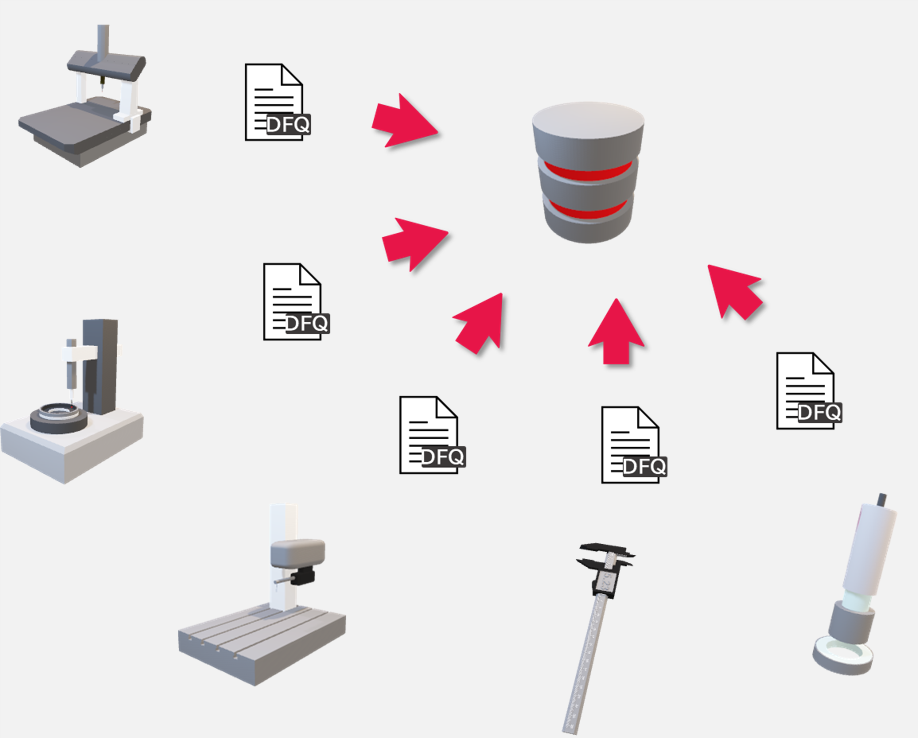
However, the cost and effort required to support different data formats for each equipment manufacturer are rising. While CAD has established official standards like STEP and IGES, no compatible, common data file format previously existed for the dimensional measurement results of those manufactured parts.
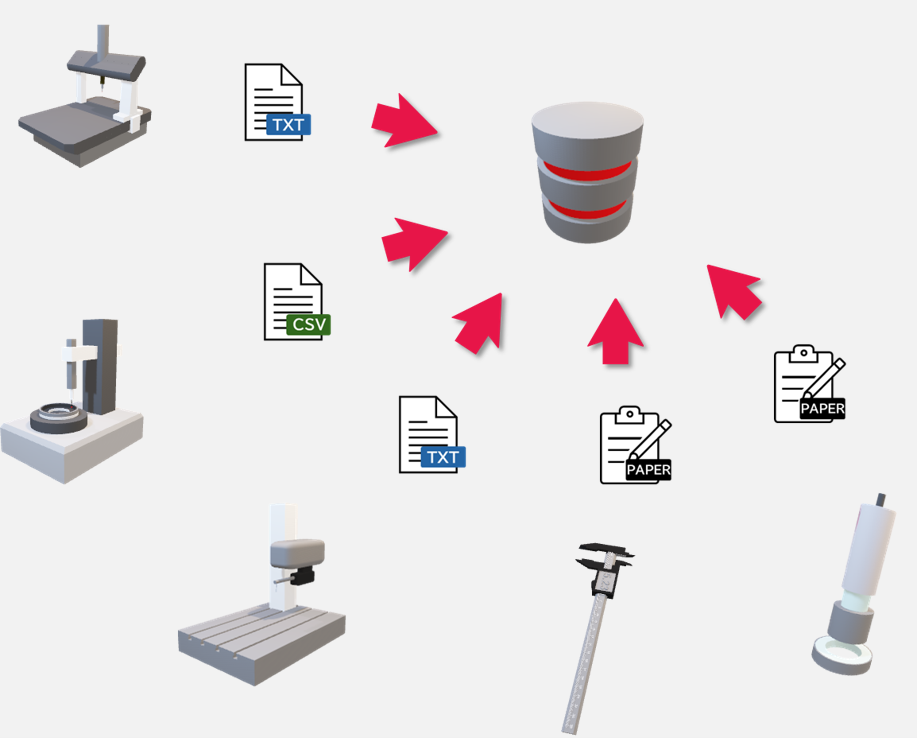
To address this, ISO/TR 11462-5:2023, Guidelines for implementation of statistical process control (SPC), Part 5: Quality data exchange format for SPC software, has been established.
Data Model
Data within a file is categorized by field numbers as shown in the table below:
| K1000 | … | K1999 | Descriptions of part data, part types, and part details. | |
| K2000 | … | K2999 | Data containing characteristic-specific information. | |
| K0001 | … | K0999 | Numerical format descriptions / Measurement values | |
| K8000 | … | K8999 | Quality control chart information. | |
| K5000 | … | K5999 | Structural information. |
File Types
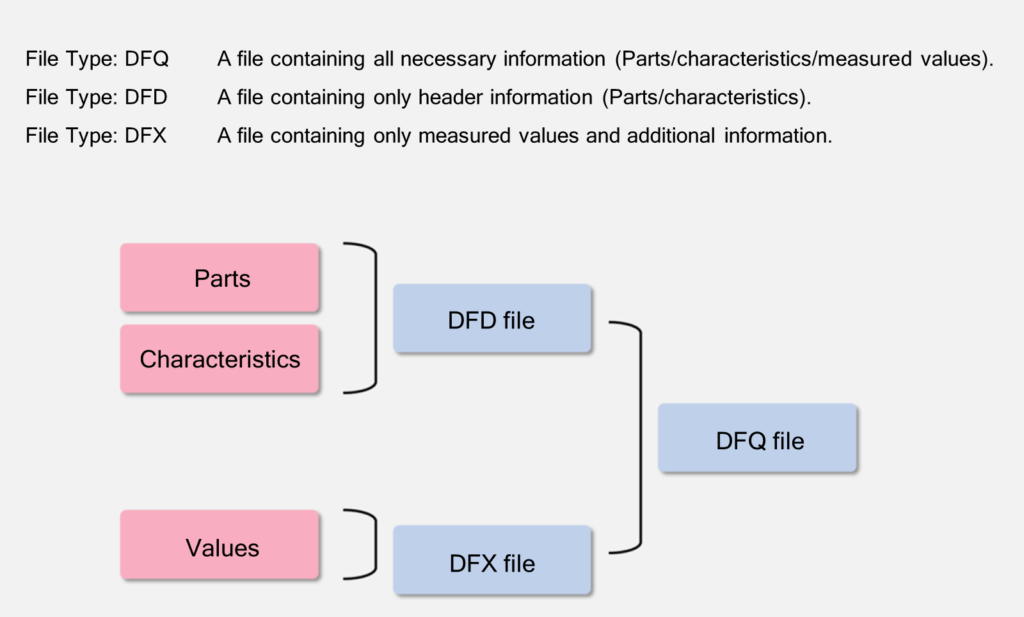
There are two patterns for file creation. Depending on the equipment's data output method, you can choose the optimal configuration:
- Single File: All information consolidated into a single file with the extension *.dfq
- Split Files: A paired configuration consisting of *.dfx and *.dfd files.
Notation Rules
- The Key number and field content are separated by a space.
- One field is described per line.
- Line breaks must use a combination of
<CR>and<LF>(Hex:$0D $0A, Decimal:#13 #10).
Example:
K0100 3(Total characteristics)
K1001/1 Part_Number
K2002/1 Characteristic_1
Mandatory Fields
he following fields are mandatory and must be included in the file:
- Total number of characteristics in the file (K0100)
- At least one field from the Part (K1xxx) group
- Recommended: Part Number (K1001) and/or Part Name (K1002).
- At least one field from the Characteristic (K2xxx) group
- Recommended: Characteristic Number (K2001) and/or Characteristic Name (K2002)
Main part field, characteristic field list
| Key | Field Name |
|---|---|
| K1001 | Part number |
| K1002 | Part description |
| K1003 | Part name abbreviation |
| ・ | |
| ・ | |
| K1041 | Drawing number |
| K1091 | Machine number |
| Key | Field Name |
|---|---|
| K2001 | Characteristic number |
| K2002 | Characteristic name |
| ・ | Characteristic abbreviation |
| ・ | |
| K2101 | Nominal |
| K2110 | Lower specification limit |
| K2111 | Upper specification limit |
Example of parts and characteristics section
K0100 3
K1001/1 P10L3
K1002/1 Work10
K1003/1 WK10
K1041/1 DW0001
K2001/1 M1
K2002/1 Z position
K2101/1 -250.0
K2110/1 -250.1
K2111/1 -249.9
K2001/2 M2
K2002/2 Straightness
K2101/2 0.0000000000
K2111/2 0.1000000000
K2001/3 M3
K2002/3 Pocket Width1
K2101/3 50.0
K2110/3 49.9
K2111/3 50.1
Main value field list
| キー | Field name |
|---|---|
| K0001 | Values (Measured values) |
| K0002 | attribute |
| K0004 | Date/Time |
| K0005 | Event |
| ・ | |
| ・ | |
| K0010 | Machine number |
| K0014 | Part ID |
Field: Date/tiem field format (K0004)
| Example fo Date/time format |
|---|
| DD.MM.YYYY/ HH:MM:SS |
| MM/DD/YYYY/HH:MM:SS |
| YYYY-MM-DD/HH:MM:SS |
| DD.MM.YYYY/HH:MM:SSam |
| MM/DD/YYYY/HH:MM:SSam |
| YYYY-MM-DD/HH:MM:SSam |
| DD.MM.YYYY/ HH:MM:SSpm |
| MM/DD/YYYY/HH:MM:SSpm |
| YYYY-MM-DD/HH:MM:SSpm |
Example of Value level field section
K0001/1 2.01
K0002/1 0
K0004/1 20.02.2022/07:29:32
K0005/1 1
K0010/1 2
K0014/1 SR0001
K0001/2 10.15
K0002/2 0
K0004/2 20.02.2022/07:29:32
K0005/2
K0010/2 1
K0014/2 SR0002
K0001/3 5.3
K0002/3 0
K0004/3 21.02.2022/08:29:32
K0005/3 2
K0010/3 1
K0014/3 SR0003
Field: Quality Control Chart
| Key | Field Name |
|---|---|
| K8012 | Lower Control Limit(Xbar chart) |
| K8013 | Upper Control Limit(Xbar chart) |
| K8112 | Lower Control Limit(R chart) |
| K8113 | Upper Control Limit(R chart) |
| ・ | |
| ・ | |
| K8500 | Subgroup size |
| K8501 | Subgroup type |
Example of QCC section
K8012/1 -249.98
K8013/1 -250.062
K8500/1 5
K8501/1 0
Catalogs (Reference Tables)
ISO/TR 11462-5 utilizes reference tables called "Catalogs."
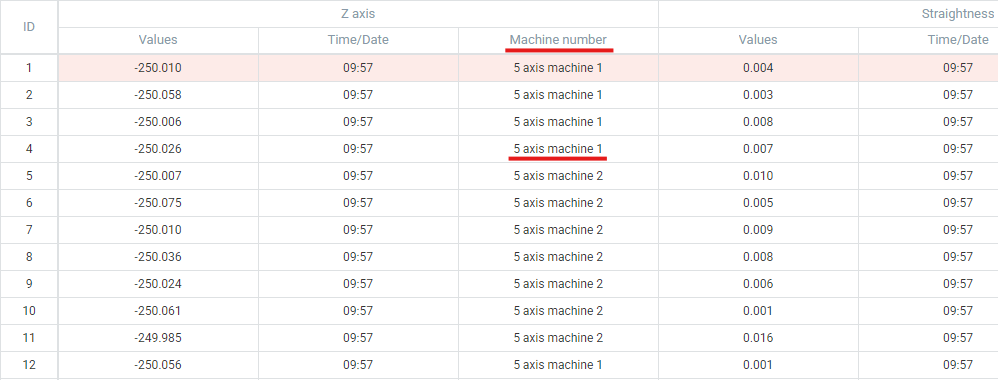
Repetitive traceability information—such as machine numbers, fixture IDs, or operator names—is pre-listed in a catalog. The numerical data then only needs to reference the corresponding ID from that table. This keeps file sizes small and ensures data consistency.
| Key | Field Name | Remark |
|---|---|---|
| K4060/0 | Machien catalog name | Applies to K field K0010 |
| K4061/i | Catalog number | |
| K4062/i | Machine number | |
| K4063/i | Machine name |
Machine catalog entry example (corresponding to K0010)
| Key | Field Name |
| K4060/0 | Machine catalog |
| K4061/2 | 2 |
| K4062/2 | M002 |
| K4063/2 | Machine 2 |
Referencing the Catalog:
K0010/1 2-->Assigns "Index 2" from the catalog to the first data point.
K0001/1 2.01
K0002/1 0
K0004/1 20.02.2022/07:29:32
K0005/1 1
K0010/1 2
On the software screen, the actual text from the catalog (e.g., "Machine 2") is displayed instead of just the number.
Benefits of Compliance
For Users:
- Equipment Selection: Select machinery based on truly critical specs (accuracy, speed, usability) without worrying about data post-processing or integration hurdles.
- Cost Reduction: Integrated existing databases with new equipment data instantly via the common format, drastically reducing the time and cost of data consolidation
For Equipment Manufacturers:
- Development Efficiency: No need to prepare multiple data output specifications for different customers, allowing R&D efforts to focus on core product innovation.
Our INDEQS series is fully compliant with the ISO/TR 11462-5 data format. We provide training on ISO standard formats and create custom conversion interfaces.
Click here for consultations or detailed inquiries.
Click here to download INDEQS brochures