

The "Survival Threshold" for Automotive Supply Chains in 2026: Why You Must Prepare for Ouranos and Catena-X Now
In an era where "proprietary data formats" become barriers to global trade, prepare to connect to international standards with iNDEQS.
Catena-X: An inescapable wave from Europe
Don't dismiss "Catena-X" as experimental projects. This is not just a European regulation or a concern only for Tier 1 suppliers.
Catena-X is a data space designed for a decentralized, autonomous federated ecosystem, aimed at reclaiming data sovereignty from mega-platforms (like GAFA). This is a permanent shift in how data is shared across the entire automotive supply chain.
Japan has been isolated from Western automotive standards until now, but this time, there are circumstances that cannot be ignored. If Japan does not join this ecosystem, an unbridgeable productivity gap will open up between Japan and Europe. In fact, with the launch of the "Uranus Ecosystem" promoted by the Ministry of Economy, Trade, and Industry of Japan, the foundation for collaboration with Catena-X is being established.
Expanding use of the decentralized ecosystem
This ecosystem, which began primarily in Germany, is not limited to CATENA-X; various other ecosystems, such as Factory-X and Chem-X, are also being established for each industry.
The aim is to decentralize data that has previously been centralized, placing it in the possession of individual companies, while ensuring data sovereignty and enabling the sharing of data, increasing convenience and promoting innovation.
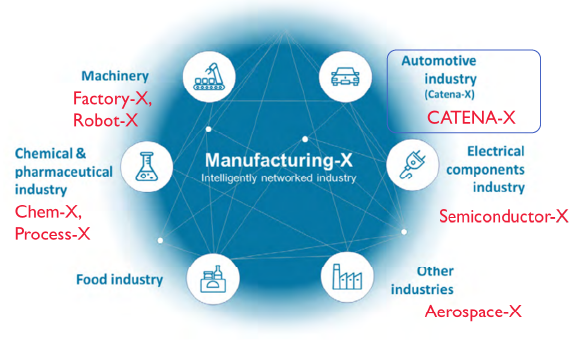
Catena-X is led by European giants such as BMW, Mercedes-Benz, Volkswagen, and Bosch, and is already in full-scale operation.
Catena-X: The European Movement
A massive ecosystem spearheaded by leaders like BMW and Mercedes-Benz. It mandates transparency in quality data and Carbon Footprint (CFP) across the entire supply chain, including Small and Medium-sized Enterprises (SMEs)
Ouranos Ecosystem: Led by the METI
A national project by the Ministry of Economy, Trade and Industry. It digitizes traceability for automobiles and storage batteries, with a focus on interoperability with European standards.
Mandatory vs. Optional
A "Requirement," not a "Recommendation." Unlike past standards (MT-Connect/OPC UA1), which were optional for efficiency, Catena-X is essential for survival. For automakers and auto-part makers, failure to participate means a dual risk:
- Being dropped from the supply chain
For an auto parts manufacturer, being dropped from the supply chain poses a major risk to the company's survival. - Missing out on massive productivity gains
The Catena-X official website states that BMW, Bosch, and Denso have implemented Catena-X to reduce defect detection by 4 months and to reduce the time required to integrate new component suppliers into their systems from several months to 5 weeks. This is a significant improvement that cannot be dismissed as "it can't be helped, we are the Galapagos Islands."
The "Language" Barrier
The biggest challenge is the data itself—often stored in "mysterious" CSVs or "My" Excel files. Converting these for sharing usually requires enormous time and costs.
- Data content and formats vary from client to client.
- Data formats generated on-site vary widely.
- Expensive modifications are required every time specifications change.
iNDEQS Hybrid Strategy: Integrating traditional ISO Standards with JSON
The international standard for quality data exchange is ISO/TR 11462-5 (Advanced Quality Data Exchange Format, commonly known as the DFQ format). It's not widely known, but the "A" formerly stood for "Automotive." (It was changed to "Advanced" after its use began outside the automotive industry.) As the name suggests, this format was designed to ensure the compatibility of quality data for automotive parts. Created by a working group of automotive-related companies, it incorporates the wisdom of its predecessors. The normalized database created from this data file is highly compatible with ecosystems such as Catena-X. There is no better format than DFQ.
However, the DFQ format has three major drawbacks.
- High Learning Curve: As it is not a general-purpose format, there are few engineers with the necessary expertise. Aligning in-house system data with this standard requires an immense investment in learning time.
- Lack of Conversion Libraries: There are no ready-made libraries to convert data from CSV or Excel to DFQ. Companies must develop their own conversion tools from scratch, leading to high development costs.
- Lack of General-Purpose Editors: There is no way to verify that the data format is correct until it is processed by a database uploader.
To address these challenges, we have reconstructed the data structure in full compliance with the standard on the highly versatile JSON format. In essence, we have remade it into a user-friendly JSON version while preserving all the structural advantages of the original standard.
Three Strategic Advantages of the iNDEQS Format
- Reduced Conversion Costs
By leveraging standard JSON libraries, iNDEQS enables rapid and cost-effective conversion of legacy Excel and text-based data. What used to be a complex integration process is now streamlined, significantly lowering the barrier to entry. - Seamless Ecosystem Interoperability
Successful data exchange via the Eclipse Dataspace Connector (EDC2) depends entirely on whether your internal database aligns with Catena-X standard models. Because the iNDEQS database is pre-structured based on JSON architecture, developing the adapters required to interface with the EDC is exceptionally streamlined, ensuring you are "ecosystem-ready" from day one. - Optimized for Quality Data DX (Digital Transformation): A database is only as valuable as the insights it provides. Unlike generic DB and BI tool combinations, which often struggle with slow data processing, the iNDEQS normalized database is purpose-built for daily quality analysis. It delivers a high-performance, intuitive environment that offers speed and depth of analysis beyond the reach of conventional tools.
The i-FLEX Advantage: Accelerating Data Transformation
High-Speed Transformation to iNDEQS Format
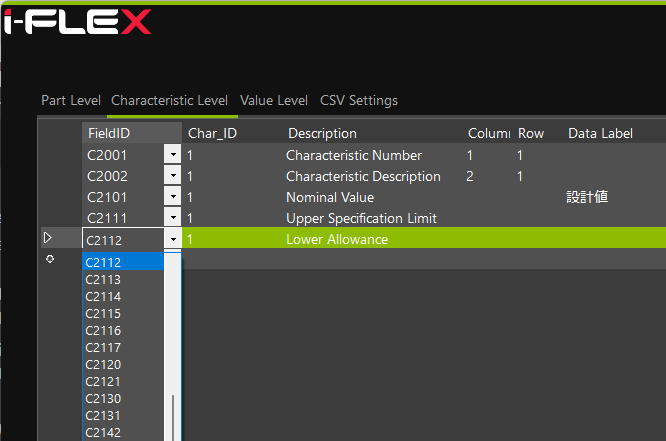
Process Artz’s i-FLEX software accelerates the conversion of standard business files into the iNDEQS-compliant format.
- Universal Format Support: Handles widely used formats, including CSV and Microsoft Excel.
- Intuitive UI-Driven Mapping: Flexibly configure and customize data mapping destinations through a user-friendly graphical interface.
- Integrated Two-in-One Workflow:
- Mapping Mode: Design and test conversion rules in a dedicated environment.
- Auto Mode: Execute high-volume data conversion and file processing automatically in the background.
- Extensible Modular Architecture:
Additional modules are available to support specialized or proprietary data formats. - High-Performance Multi-threading:
Engineered for speed, i-FLEX supports simultaneous processing of up to 10 different formats and conversion rules.
Don't miss the wave!
The shift to EVs and SDVs (Software-Defined Vehicles) demands a shift from "Paper/Excel" to "Digital Data Integration." Ride this wave of transformation with iNDEQS.
As a first step, why not evaluate your current data structure?
Do you have quality data still managed in Excel or legacy systems? Our expert team is ready to provide a diagnostic assessment to support a smooth transition to iNDEQS.
notes